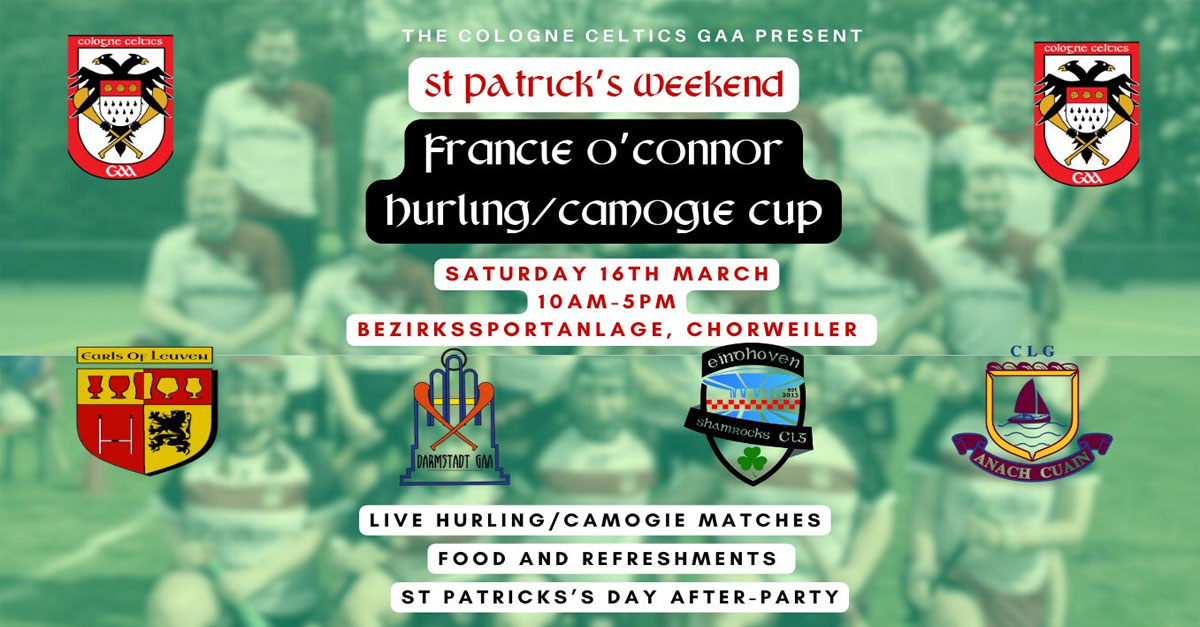
Save the Date! On St. Patrick’s Weekend (Saturday, 16th March), the Cologne Celtics GAA Club is back in hurling and camogie action with the second Francie O’Connor Hurling Cup.
We will be playing at Bezirkssportanlange Chorweiler (Merianstraße 5, 50769 Köln). The event is free to attend and is open to the whole family.
At the Celtics, we welcome everyone interested in our club and in Gaelic Sports around the Rhineland (and further afield) to come and watch. The first match will start at approximately 10:00am and continue until 5:00pm.
We are thrilled to welcome Leuven GAA (The Earls of Leuven), Eindhoven Shamrocks GAA, Darmstadt GAA and Annaghdown GAA to Cologne for this invitational tournament.
The players from Annaghdown GAA are making their way over to Cologne from Galway, Ireland. This is the second time that the Cologne Celtics have had Irish opposition visit us, following on from the successful visit of Monagea GAA last year.
Eindhoven Shamrocks will be seeking to defend their trophy. During an immense day of hurling action, „the Shams“ came out victorious last year – as they won all three of their matches – and went away with the well-deserved trophy.

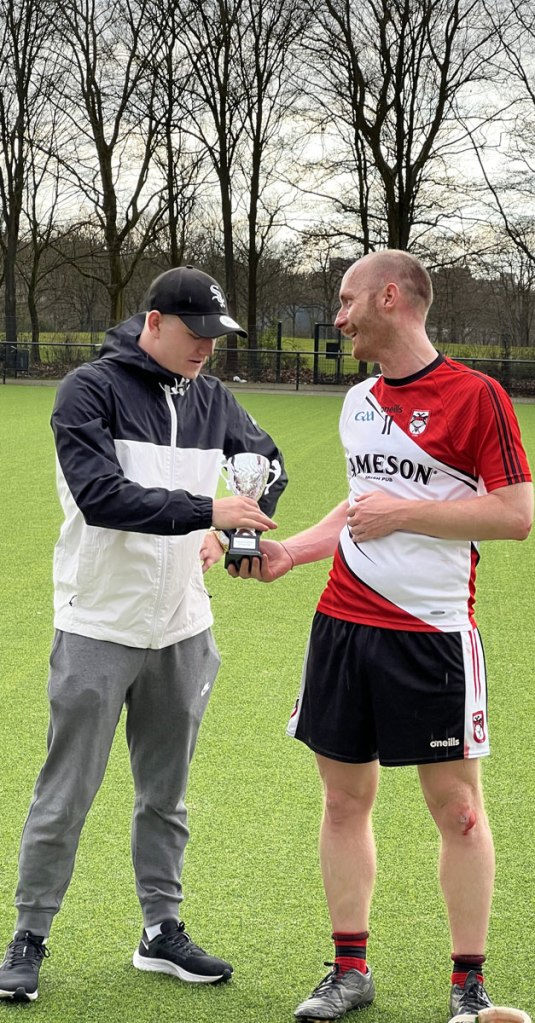
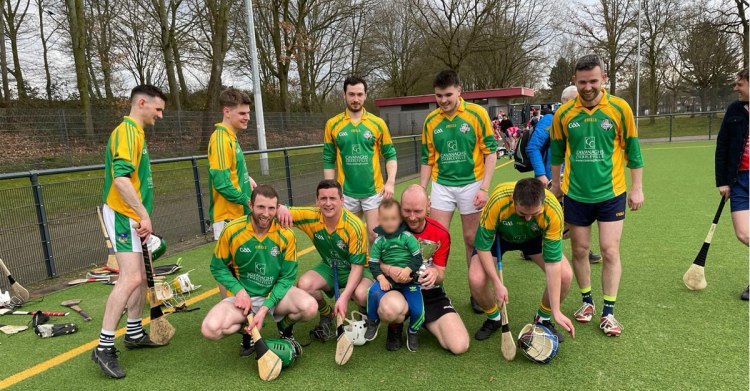
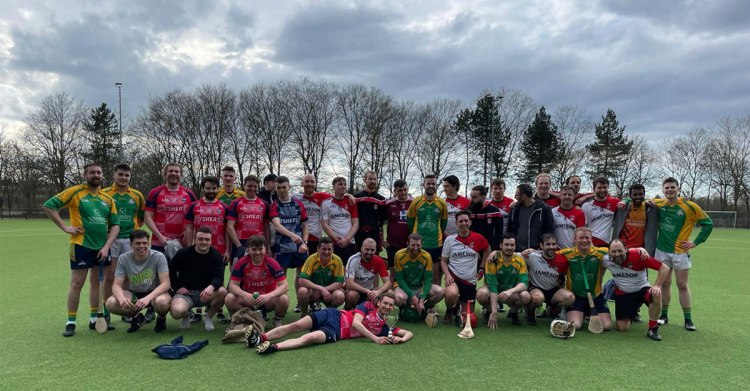
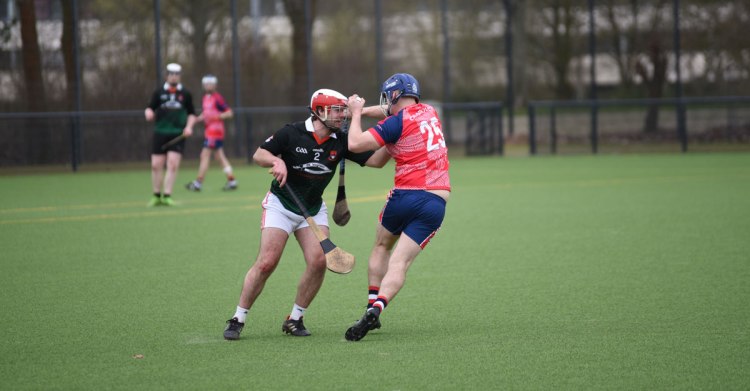

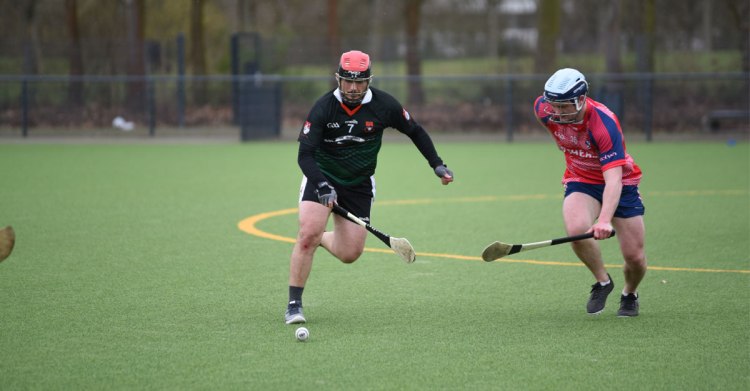
Although the Cologne Celtics didn’t win the trophy on the day, we still took pride in that we had twenty-six male players available on the day – between our first team and our Düsseldorf/Rheinland Gaels team. We also had an army of volunteers who helped out enormously on the day. We are expecting similar numbers in the second edition of the tournament.
Furthermore, this year, we are delighted to be able to host a camogie tournament to coincide with the hurling tournament. The Cologne Celtics Camógs can’t wait to take to the field. As well as our veteran players, some new camógs will get their first experience on the pitch.
We are looking forward to welcoming players from Eindhoven, Leuven, and Darmstadt for what is sure to be a great day. You can expect fierce competition to see who will be the inaugural winner of the camogie tournament and, of course, good craic and camaraderie amongst the camógs.
Getting to the Tournament
The tournament will take place at Bezirkssportanlange Chorweiler (Merianstraße 5, 50769 Köln).
For those driving, plentiful parking options are available at the location of Bezirkssportanlage Chorweiler. The best public transport option for those coming from Cologne Centre is the S-Bahn S11 to Köln-Chorweiler from Köln Hbf.
Although the tournament starts at 10am for the players, supporters can arrive at any time throughout the day. Refreshments will be available at the pitch.
Who are the Cologne Celtics?
The Cologne Celtics Gaelic Sports Club, e.V., is the Domstadt’s only GAA club. We are a team consisting of players from Ireland and Germany and further afield. Our teams and players compete regularly in GAA tournaments across Germany and Europe. Since the start of youth training last year, our club now offers youth training to go alongside our adult teams and our club is developing and growing every year. If you are interested in joining the Cologne Celtics, you can find the link here on our website.
During the winter season, we train every Monday night at Bezirkssportanlage Bocklemünd (Heinrich-Rollmann-Str. 50829 Köln), and we are always looking for new players and members, regardless of experience level. As well as on-field training, we offer off-the-field events, such as watching live hurling and Gaelic football matches at our sponsor pub, Jameson’s Distillery Pub, Irish language classes and Ciorcal Comhrás and our regular Live Music Sessions at the Black Sheep Pub.
If you would like to find out more about the Cologne Celtics, please do not hesitate to contact us directly.
Our Opponents
Annaghdown GAA
Annaghdown GAA is a GAA club that is deeply rooted in the parish of Annaghdown along the shores of Lough Corrib in Galway. It has a rich history dating back to its establishment in 1887, just three years after the foundation of the Gaelic Athletic Association (GAA) itself. The club’s name, Eanach Dhúin, meaning „The Marsh of the Fort“, reflects its geographical and cultural ties to the region. From its early years, Annaghdown GAA has been a prominent figure in Gaelic football and hurling in the area, playing a pivotal role in shaping the sporting landscape there.
In the realm of football, Annaghdown GAA has seen notable successes, with significant milestones including their first county senior title in 1931 and subsequent triumphs in the 1980s and early 2000s (1931, 1982, 1985, 1987, 2001). The club’s resilience and competitive spirit have been evident throughout the decades, with multiple county titles under their belt and a continuous presence at senior levels, though the ultimate prize of the Frank Fox Cup (Galway Senior Football Championship Cup) has remained elusive in recent years.
Similarly, in hurling, Annaghdown has left its mark, tracing its origins back to the 1920s but experiencing a resurgence in the late 20th century and beyond. Guided by dedicated coaches and fueled by a passion for the sport, the club has claimed numerous titles at various levels, including a historic national Féile title in 1980, making them the first Galway club to achieve such a feat. Find out more about the history of Annaghdown GAA by visiting their website.
Thanks to our Galway Celt, Ciarán Harkin, for establishing the connection between our clubs.
The Earls of Leuven GAA
The Earls of Leuven GAA club was founded in 2015, and they started playing their first matches the following year. Leuven has had a strong connection to Ireland since at least the 17th century, with the Irish College of St Anthony (Coláiste na nGael i Lobháin/Iers College Leuven) opening its doors in 1607. It was opened by the Archbishop of Tuam and an Irish Franciscan, Hugh MacCaghwell, who would later become the Archbishop of Armagh, as an exile institution for the training of Irish Franciscan priests.
The current Irish College Leuven was founded in 1984 on the site of the older college. It is an international residential centre for education, training and research in European and international affairs. Its stated mission is to maximise the promotion, positive exposure and opportunities for the island of Ireland. In addition, the college organises and hosts cultural and artistic events from and related to the island of Ireland.
The Earls of Leuven GAA continue to build on that tradition, and they are growing year by year. In 2018, they became an affiliated University sports club with KU Leuven (Katholieke Universiteit Leuven). That was also the year they introduced hurling to the club. In 2019, they founded their ladies teams.
They have gone from strength to strength in recent years. Last year, they had 11 players and 2 managers represent them at the GAA World Games in Derry; they sent full teams to the Pan-Europeans in Den Haag, hosted the first Benelux Development Football Tournament and also sent a team to our round in Cologne. We are delighted to build on our connection with Leuven by hosting them again in the Domstadt.
Eindhoven Shamrocks GAA
The Eindhoven Shamrocks GAA Club was founded in 2013 to provide GAA training and opportunities for the large Irish expat community that had settled in Eindhoven and the surrounding areas. Since then, the club has developed and attracted players of all levels and nationalities.
Eindhoven has become a familiar opponent of the Celtics in recent years. We have played them in several rounds of European hurling, and last year, they won the inaugural Francie O’Connor Trophy.
We got some revenge in the Shield Final of the European Hurling/Camogie Championship 4th Round last year when our hurlers overcame Eindhoven in a tough final. This victory was our first trophy win at European level, and it came after a tough final where we came out of it with a two-point victory.
We are looking forward to welcoming Eindhoven back to the Domstadt
Darmstadt GAA
Darmstadt GAA is one of our oldest rivals, friends and enemies… We have battled with and against the players of Darmstadt across GAA fields in Germany, Ireland and the rest of Europe. We have faced Darmstadt in German Cups, European rounds, and challenge matches (including our first match after Covid lockdowns in 2021), and our players have lined up alongside them as part of Team Germany at the World Games.
However, familiarity does not breed contempt, and we know exactly how hard it will be to face off against Darmstadt. We greatly respect what they have achieved in building their club, and they represent an alternative model of club building to the usual method of primarily Irish people abroad coming together to lay the foundations of a club. Darmstadt is a proudly German club, and its club members are mostly German.
Last year, they hosted the 2023 edition of the German Hurling and Camogie Cups, and they are now continuing to build their ladies‘ section. Darmstadt, as a club, consists of fantastic ambassadors for our sports in Germany, and we look forward to welcoming them back to Cologne!
What is Hurling and Camogie?
If you are new to the Irish sports of „hurling“ and „camogie“, then it is time to learn more about it! We welcome people of all experience levels of our sports at the Celtics.
Hurling and camogie (the female equivalent of hurling) are the national sports of Ireland (alongside Gaelic Football). Hurling (iománaíocht in Gaeilge) has roots in Celtic times and is thought to go back around 3000 years. Every year, the hurling, camogie and Gaelic football All-Ireland Championships capture the imaginations of people around Ireland and further afield as the counties of Ireland battle throughout the summer for the ultimate reward.
Hurling and camogie are sports that rank among the fastest sports on grass. Those new to the sport have described them as similar to a combination of ice hockey (albeit on grass) and lacrosse. However, one of the best ways to get a feel for the game is by watching this video:
Hurling and camogie matches in Ireland consist of 15 players on each team with the aim of outscoring your opponent. A team generally includes one goalkeeper, six defenders, two midfielders and six attackers (forwards) on a pitch between 130m and 145m long and 80m to 90m wide.
Due to smaller pitch sizes and usually fewer playing members, European teams typically have 9 players, while camogie matches can have 7 players. The goalposts are similar to rugby but with a goalkeeper between the posts. A goal is worth three points, while a point is scored if it goes above the goal’s crossbar but between the posts.
Describing hurling and camogie in such basic terms doesn’t do justice to the sport. To understand what it feels like to play, we can recommend this article written by some of our other players: „Our German Players Describe Gaelic Sports“. Another article outlining camogie, in particular, is „Gaelic Sports für Frauen mit den Cologne Celtics„. The aim was to say what hurling and camogie are like for those playing for the first time as an adult.
If you are intrigued by our games and want to try them out and/or join the Cologne Celtics, please do not hesitate to contact us directly.
We would love to hear from you and will gladly provide more details regarding how you can get involved with us. You can learn more about how to join our club and become a Celt on our club website.
Kölle abú!
Tournament poster design: Credit to club Social and Cultural Officer Gareth Houston.
 Cologne Celtics