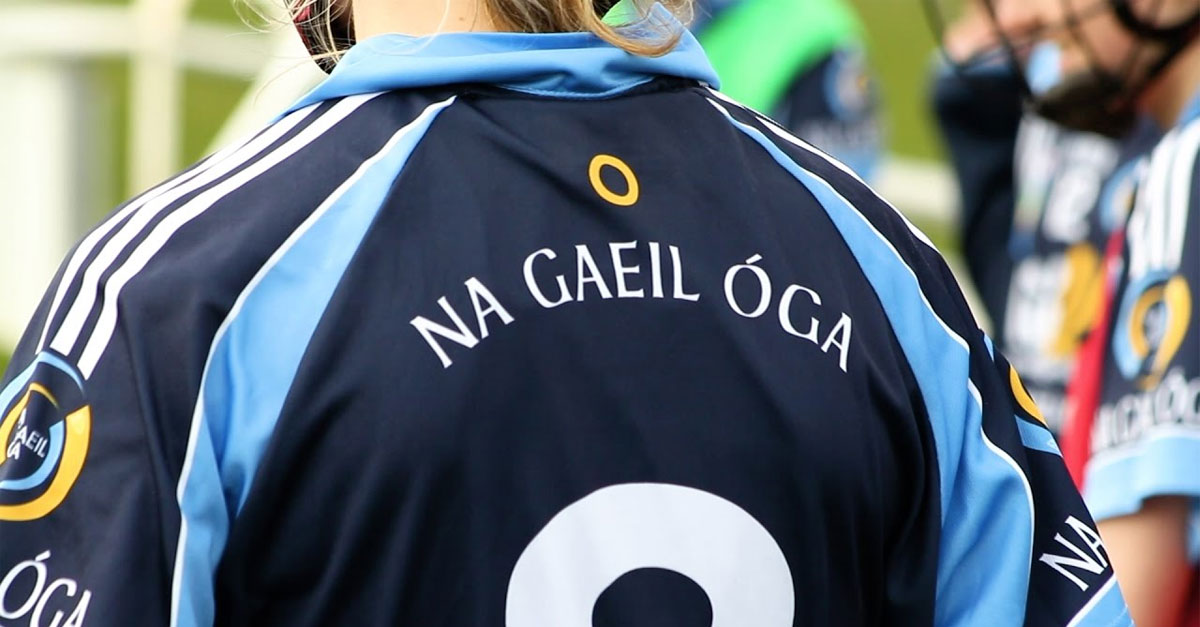
Na Gaeil Óga is an Irish-speaking GAA club based in west Dublin. It is one of very few GAA clubs outside of the Gaeltacht areas in Ireland (Irish-speaking areas), where the Irish language (Gaeilge) is the club’s first language. Since its foundation in 2010, Na Gaeil Óga has been one of Ireland’s fastest-growing sports clubs, with approximately 600 players across 35 teams in hurling, Camogie, Gaelic football and Ladies‘ football.
With Seachtain na Gaeilge (Irish Language Week) approaching, we chatted with the club’s founding chairperson, Daithí de Buitléir, about the club’s development and hopes for the future. Bain sult as (enjoy it)!
Daithí: „I didn’t actually like Irish in school. My mother and I had an argument when I was in my Second Year of school because I wanted to do pass Irish (lower-level Irish). She told me that I could do lower-level Irish if I went to the Gaeltacht for the summer. She had asked me to go to the Gaeltacht before, and I had no interest in it. So, with this promise in mind, eventually, I agreed to go, thinking it would be worth it if I didn’t have to study this language. I went to the Gaeltacht, and I had a great time. When I came back, my mother asked me if I enjoyed it, and when I said I did, she said I could go back there the following summer if I was still studying Honours Irish this time next year. I just thought to myself that that was sneaky.“
Daithí de Buitléir continued with higher-level Irish. He later studied Business and Irish (Gaeilge agus Gnó) at DCU and today is the Programme Manager of Gaeilge 365, Dublin City Council’s Irish language innovation unit. He describes Gaeilge 365 as a new approach in the public sector to come up with and implement new and innovative ways to grow the number of people who speak Irish on a daily basis. He is also a founding member and founding chairperson of Na Gaeil Óga, an Irish-speaking GAA club based in west Dublin.
The club was founded in 2010 by a group of younger people – university students – who wanted to create an opportunity for them to use Gaeilge in their everyday lives. The use of Gaeilge in Ireland is more associated with more rural areas, particularly certain designated areas called „Gaeltachteanna“, for example, An Daingean/Dingle in west Kerry, An Rinn in Waterford, An Spidéal and An Cheathrú Rua in Galway, where Irish is the community language. West Dublin – Lucan and Leixlip, where Na Gaeil Óga club is based – is not considered a Gaeltacht. Traditionally, urban areas have been amongst Ireland’s weakest areas for Gaeilge use.
Daithí: „It (the club) was born out of maybe a slight frustration that there was nowhere, really, for young people who could speak Irish to meet other young people who could speak Irish. That’s really what we’re about. We’re about providing a place for people who want to play the GAA through the medium of Irish.“
I asked Daithí about the reaction to the club since its foundation – locally, nationally, and even further afield. I wanted to know if there had been any negative comments/hostility at the club’s beginning or since the club developed.
Daithí: „The reaction since the club’s foundation hasn’t always been easy. When we were starting out originally, some national newspapers wrote extensive enough articles listing all the reasons we’d fail. We’ve shown that they were wide of the mark… Generally, the on-the-pitch reactions have been good. Players are often surprised when playing us because they sometimes don’t even know we’re an Irish-speaking club before playing us. And then, after a few minutes, they can be pretty complimentary about us speaking Irish, and you’d be amazed at the amount of people from other teams who start speaking Irish back to you.
However, there have been a few times where we have received negative comments like, „Come on, lads, when we were winning championships at the end of the year, these leprechauns are going to be doing their céilí dances“ or some sort of rubbish like that. Some refs have refused to take player names in Irish. The odd time you may get a snide comment, but I think you can count on one hand the number of times that’s happened over the last 12/13 years. By and large, people are very positive.“
In Ireland, nearly all children learn Irish/Gaeilge in school, from primary level all the way through to the Leaving Certificate at 18/19. Many people complain afterwards that after 14 years, they have learned nothing of the language, that they had bad teachers or that the curriculum wasn’t designed for using the language, and of course, this may have been the case for them…
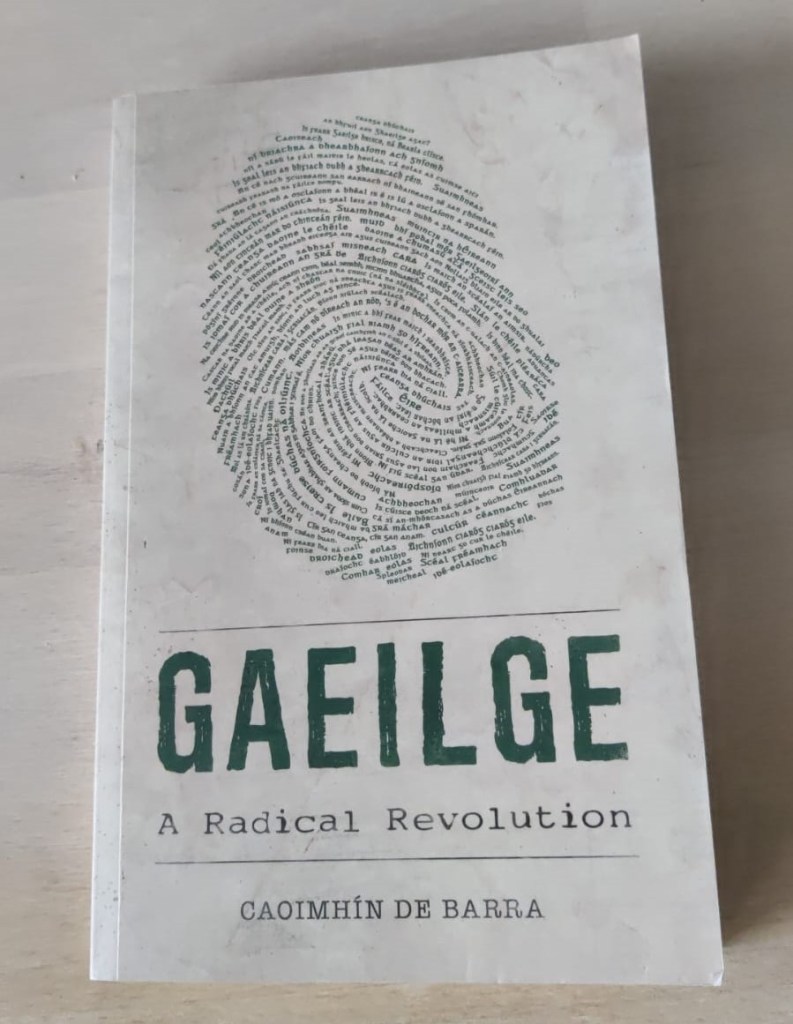
However, even for those of us who do learn a lot of Irish in school and leave with a high level of Irish, maybe from a passion and strength in language learning or due to attending a Gaelscoil (Irish-language school), there can be frustration about not being able to use it in your everyday life. If you don’t lose a language regularly, you can lose it. Everything in life in Ireland can be done through English, so the need for Irish and usage of the language in daily life and interactions can sharply diminish – this is excellently outlined in the book „Gaeilge: A Radical Revolution“ by Caoimhín de Barra.
The situation is improving now compared to many years ago with the TV station TG4 providing some excellent shows in Irish – including many GAA-related ones (but not exclusively) – Pop-Up Gaeltachts and Sosanna Lóin appearing all over Ireland (where people can go for an Irish-speaking evening or lunchtime with others who want to use the language), and a considerable increase in independent content online such as YouTube channels and podcast series delivered in Irish.
Na Gaeil Óga is a shining example of this development as a Dublin club that does everything through the language. Daithí outlined how the club integrates Gaeilge into its GAA activities on the pitch and other aspects off the pitch, such as fundraisers and other activities. Essentially, what makes an Irish-language club different from an English-language club, and how can GAA clubs help boost the language?
Daithí: „What I find interesting is the role of the Irish language in the GAA, and one of the objectives of the GAA is to promote the Irish language. There probably needs to be a conversation about how to get more Irish language GAA clubs going. If you were to take your average GAA club that operates predominantly through the medium of English and look at the number of opportunities they have to promote the Irish language, Maybe if they’re running, on average, five or six or seven or eight events or classes or Ciorcal Cómhrás („speaking circles“ – an Irish language event) or whatever a month. Collectively, those are engaging maybe 300 people… just as an example. If we look at some of the massive urban clubs over a year, that’s creating, let’s say, kind of 3600 opportunities to speak Irish, whereas a medium-sized Irish-language club like us, we’re probably producing 90 to 100,000 opportunities a year.
We promote the Irish language through everything we do, so for English-speaking clubs, it is probably more work to promote Irish and do everything else involved with running a club… In contrast, for us, Gaeilge is integrated into everything we do. Everything we do is through Irish. That’s like dinner dances, table quizzes, training courses for coaches and child safety stuff, all the usual events and courses that other clubs do. We just do it through Irish.“
So the question then becomes, is there a significant demand for an Irish-speaking GAA club? Many people (well, online commenters) would give the impression that Gaeilge is a dead language… so is that the case? And can an Irish-language club attract people from a non-Irish-speaking background? Are the members exclusively made up of fluent, native Gaeilge speakers… What level of Irish does a person need to join Na Gaeil Óga? I put all these questions to Daithí.
Daithí: The sheer level of demand has surprised me most about the club’s development. When we started, I wouldn’t have thought there would have been that big a demand. Also, I thought at the start that getting managers would be easy because it seemed that many middle-aged or more mature people were interested in the Irish language. However, I underestimated the number of young people interested in Gaeilge, as getting players to join us has been much more straightforward. It’s actually challenging for us to get managers. Most of our adult teams have player-managers.
What’s interesting is that loads of those people know us as just the local GAA club, or they just have friends who are playing and they want to play, and maybe their level of Irish isn’t great starting off, but because we do everything through Irish, they’re just immersed in it and quite quickly they pick it up. We’ve examples of people who’ve never done Irish for a day in their lives in school, have never opened a book, never done any form of formal learning, and just playing with us for a few years, they’ve become fluent in Irish. Generally, we don’t care how much Irish you have; just make sure you speak the Irish you have with us.
We get loads of people from outside of Ireland as well. Maybe two or three years ago, we’d over ten people outside of Ireland playing with our adult teams. People from Germany, the USA, Australia, England, and Spain, and a Brazilian camogie player, among others. Some of them came to Ireland because they wanted to improve their Irish. Others joined because they maybe had friends or boyfriends or girlfriends, whatever, involved in the club, and they thought that this was the best way for them to learn Irish. They decided to give it a go.
Na Gaeil Óga is not only an Irish-speaking club, but it is also a relatively newer GAA club and, therefore, does not have the deep tradition that clubs with over 100 years of history have. Players cannot say (yet) that their grandparents played for or were involved with Na Gaeil Óga back in the day, etc… GAA club members tend to remain connected to their club throughout their lives – the club they joined as a child – and unless they move far from home (such as to the Cologne/Rheinland area, in our case), people tend to stay with their club. Have there been challenges in attracting people to join this new club, and has the Gaeilge element – that USP (Unique Selling Point) -within Na Gaeil Óga played a role?
Daithí: „One of our biggest challenges is that some of the clubs around us are some of the biggest GAA clubs in the country. These clubs could have 3,000 or 4,000 members. We’re not small by any stretch of the imagination, and we would be a sizeable club in any other part of the country. In fact, most clubs in the country would bite their hand off to have the numbers we have. But the constant challenge for us is regarding people who maybe do not come from GAA backgrounds, as they might look and see a club up the road with 120 8-year-olds, and they might see us with 15 or 20. Sometimes, it is difficult for people to understand that maybe a child might be better off and, in many cases, they probably would be better off with our 15 to 20 8-year olds than with another club, where their child is one of 120. When players join our club, we need to ensure they stay and fall in love with the games. On a bigger club, where they might be one of 120, at the end of the day, if they slide and fall away from the club, that club will still have enough players for teams next year.
Another aspect I like to look at is players‘ attachment to their clubs. Obviously, we’re a newer club and always looking for new members. So, it is fun to come across people who say that Gaeilge is essential in their lives, but when you ask them if they want to come to play for Na Gaeil Oga, they can’t leave their club. I fully understand that mentality, but it’s interesting how deep that kind of parochialism goes for some people. For other people, there may be a choice of playing senior club football or playing for an Irish language club. Some might join us, but it is a very personal choice, and we know that.“
Leixlip, Lucan and West Dublin generally wouldn’t be considered traditional Gaeltachts, so that the club has grown and developed so much in such an environment is fantastic to see. Daithí was happy to point out the partnerships and collaborations Na Gaeil Óga has had with other organisations within the GAA community and those focused on promoting Gaeilge. He also highlighted the value of engagement with the local community and schools in building the club’s overall identity.
Daithí: „The local schools have been the most significant partnerships for us as probably 70% of our membership consists of the juvenile section. Predominantly, our members come from a couple of Gaelscoils around Lucan and Leixlip in west Dublin, and those schools have been vital. We have also had strong support from many different Irish language organisations over the years. Dublin County Board have also been very helpful. We do a lot of work in the local area to strengthen our image and share what we’re about with the local community, particularly on the juvenile side.
I love working with the kids. A great memory of working with the kids was from just before Christmas some year. We were presenting medals to an under-15 team, and there were maybe 200 people in the hall. One of the players just turned to me and asked to address the crowd. They talked about how grateful they were for the club, how much the club meant to them, and how much the club meant to the group, the friends they had made, the importance of the club, the language, and everything. And that, for me, is massive. I think seeing a group of people coming through from the ages of four or five who’ll grow up, and in many cases, unless they go on and play at the intercounty level, will never play GAA through the medium of English. They will play on school teams with the Gaelscoil and club teams with us, and everything is through Irish.“
To conclude our chat, I asked Dáithí about the club’s goals for the future, both in terms of GAA achievements and the promotion of the Irish language. I also sought his advice for individuals or groups interested in promoting Gaeilge within their own GAA club in Ireland and abroad.
Daithí: „Ultimately, if you get to the stage where you have the best team in the country and the worst team in the country in a given year, I think you’re doing reasonably well. What I mean by that is I think there’s a challenge within the GAA of how to maintain a participative ethos while also facilitating people to be the best they can be. And I think many clubs have maybe gone in the direction of facilitating for the best to be the best, but at the same time, have lost sight of that kind of participative element, which is, I think, essential.
Regarding the Irish-speaking element, I think the Irish language and the GAA can be strong connection points with Ireland for those living abroad. To keep the language going when abroad, if you know someone who has Gaeilge, speak Gaeilge to them; I think that’s the simplest thing anyone can do and create connection moments for those people to identify with each other.
In Ireland, I think the biggest thing people could consider is creating more Irish-speaking GAA clubs. It is not always easy, of course; I understand that. In the same way that Gaelscoileanna – Irish language schools – have sprouted up and expanded, we probably need to look at how we can get more Irish-speaking GAA clubs. One of the most heartening things about our journey over the last 12/13 years is seeing the likes of Gaeil na Gaillimhe from Galway and Laochra Loch Lao in Belfast take up the kind of mantle and really drive forward. And hopefully, in 20/30 years, there’ll be Irish-speaking GAA clubs in urban areas all across Ireland.“
Go raibh míle maith agat ar son an am a thógaint, a Daithí. Thanks a million for taking the time to talk with us, Daithí; we greatly appreciate it. If you would like to find out more about Na Gaeil Óga, make sure to visit their website and follow them on Social Media.
If you are interested in learning Irish in Germany, Conradh na Gaeilge in Berlin and Conradh na Gaeilge in Hamburg are very active in teaching new students. There are also groups, such as Ciorcal Cómhrá Stuttgart and Pop-Up Gaeltacht Frankfurt hosting regular events.
If you are based in the Cologne-Bonn area, please get in contact with our club directly if you are interested in learning some Gaeilge with our players. We can keep you informed about our plans and meetings.
Top Image courtesy of The42.ie.
 Cologne Celtics